
South Milwaukee Directory Shelves
The South Milwaukee Public Library local-history collection is the main starting point for historical resident research. Its city and telephone books cover 1911 through 1980, with gaps and missing years. Each volume is a snapshot. It may list a subscriber, householder, or business but not every person who shared an address. Record the year, page, spelling, and street exactly as printed before moving to another source.
| Collection | Years | Where Held | Access |
|---|---|---|---|
| City and telephone directories | 1911-1980, with gaps | South Milwaukee Public Library | Finding aid, library use, and selected digital pages |
| South Milwaukee newspapers | 1893 and 1899-2006, with gaps | Library newspaper archive | Free keyword search online |
| Bay Mist yearbooks | 1926-2012; 1933-1935 absent | South Milwaukee Public Library | Library collection |
| Bucyrus-Erie Scoop | 1919-1983 | Local-history collections | Industrial and civic name leads |
| Photos and scrapbooks | Mostly 1920s portraits; 1930-1992 scrapbooks | Library and partner collections | Ask about item metadata and reuse |
The library's physical finding aid should be checked before a trip. It identifies South Milwaukee books and regional Milwaukee City and County directories, including Polk and Wright's volumes, and notes that some items are stored in the basement. Regional books must be checked volume by volume because a Milwaukee run does not guarantee South Milwaukee suburban coverage.
South Milwaukee Directories Online
The library's digital project launched in 2021 with the South Milwaukee Historical Society, South Milwaukee Industrial Museum, Recollection Wisconsin, and the Alex and Meta Stosick collection. The South Milwaukee digital collection includes selected directory material, photographs, and other local records. It is not described as a complete scan of every volume on the shelf.
A visible 1929-30 directory item shows why researchers should retain the item ID and volume label. The text interface did not expose dependable optical character recognition, so a typed search may miss a name that can be read on the page image. Browse adjacent pages, try initials, and inspect the scan rather than inventing details from a catalog record.
The 1929-30 directory image and record show the digital viewer used for South Milwaukee material.
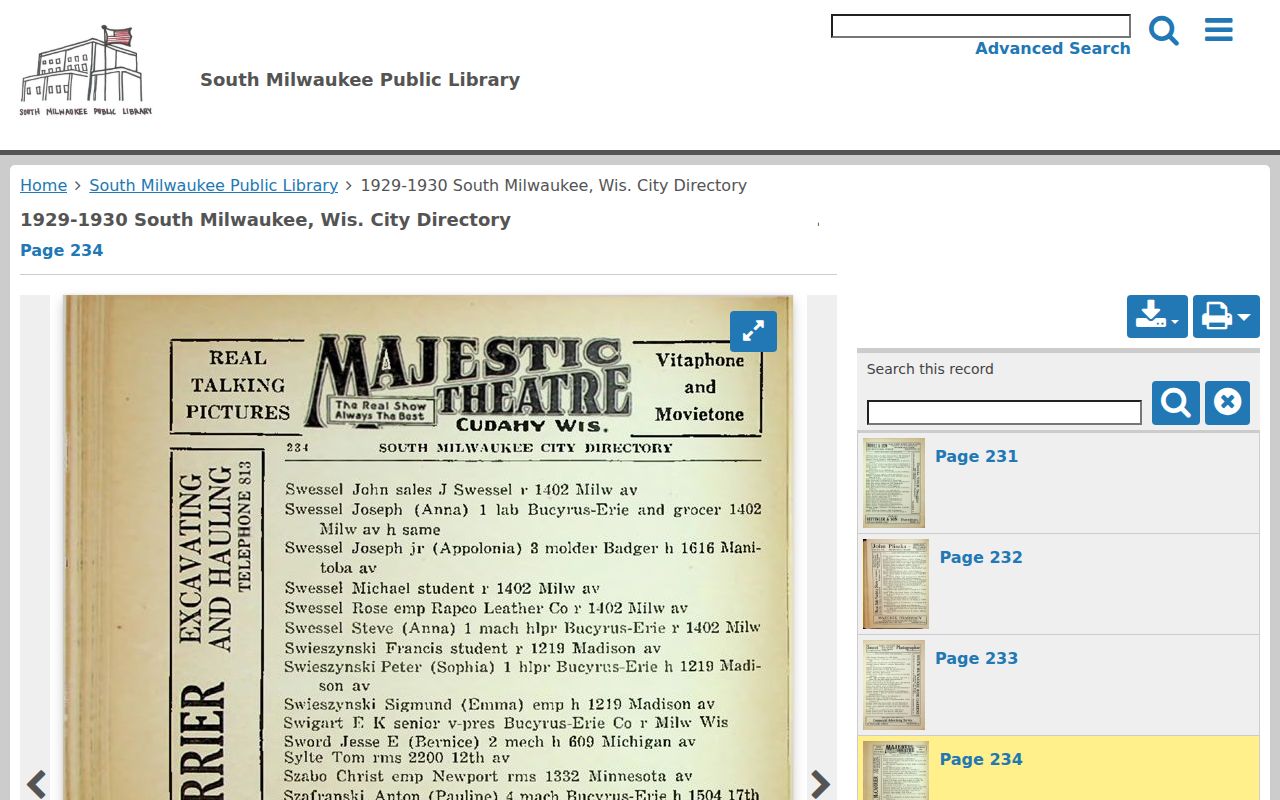
The viewer supplies a stable item context, but the page image remains the source for any exact name, address, notation, or page citation.
South Milwaukee Local History Access
The local-history landing page brings together digital and physical holdings. Read the finding aid, search the digital collection, and then contact library staff about volumes or boxes that are not online. A useful request gives the surname, street, date range, and source type. Ask whether an item is on site, in basement storage, or available only through a partner.
The library's local-history page shows the available routes into its South Milwaukee records.
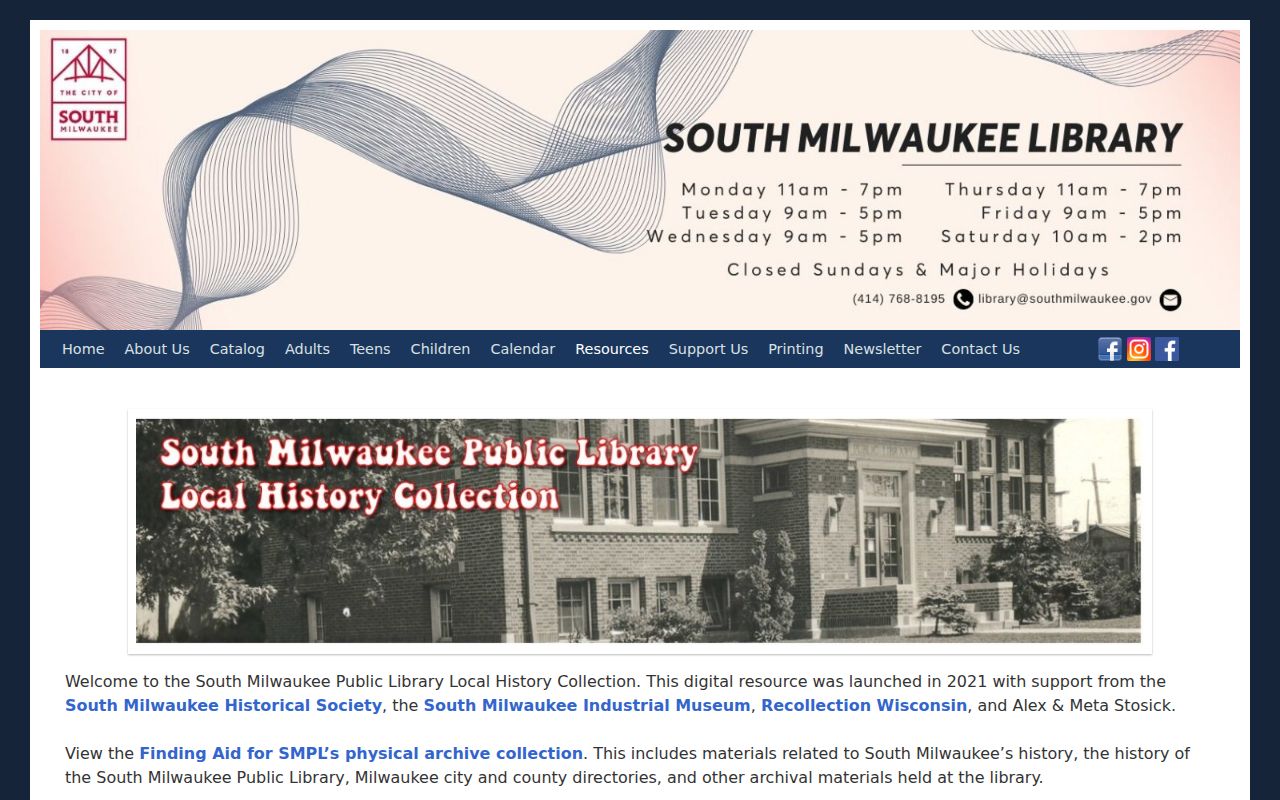
This library overview is the best handoff when a city directory search must expand into yearbooks, newspapers, photographs, or the physical finding aid.
For a deeper county-level search, the Milwaukee County Historical Society Research Library holds directories, deeds, old court and naturalization material. Its research library at 910 N. Dr. Martin Luther King Jr. Drive uses two-hour appointment blocks Tuesday through Saturday, as posted for February 2026. Remote requests were listed at $15 for simple research and $25 for complex work with stated scan and copy allowances, plus added charges where applicable. Confirm hours, holdings, and costs before ordering.
Note: State the South Milwaukee year range and exact surname or street so staff can distinguish local books from Milwaukee city volumes.
Read South Milwaukee Directory Entries
Read only what the scanned South Milwaukee page actually shows. The inspected digital record did not yield a reliable text transcription or a confirmed local abbreviation key. Generic conventions can help form questions, but they cannot be assigned to a local entry without seeing the page and the key from that volume.
| Volume identity | Title and year printed on the directory or catalog record |
|---|---|
| Page position | Image or page number and nearby alphabetical entries |
| Printed name | Exact spelling, initials, and any name qualifier visible |
| Street line | House number and street exactly as printed, if present |
| Other marks | Telephone, business, spouse, or status marks only after checking that volume's key |
- Criss-cross directory
- A directory arranged by street or telephone number rather than only by surname. No separately titled South Milwaukee run was confirmed, so inspect each volume.
- Householder index
- A name list centered on the person associated with an address. It may omit other people in the household.
- Abbreviation key
- The volume's own legend for shortened terms and symbols. Save it with the entry because meaning can change by publisher and year.
A listing proves that the publication associated a printed name with a printed place during its directory year. It does not alone prove a move-in date, ownership, every household member, or continuous residence. Pair it with a second dated source.
South Milwaukee Names Beyond Directories
The South Milwaukee newspaper archive states coverage for 1893 and 1899 through 2006, with gaps. An early-range description has a typo, so preserve the clearer stated years and never treat a failed search as proof that a person was absent. Try full names, initials, spelling variants, street names, and organizations. Notices may connect a name to an address, marriage, obituary, sale, or civic event.
Bay Mist yearbooks span 1926 through 2012, but the stated holdings omit 1933 through 1935. A yearbook can identify a class, activity, caption, or staff role. It is not a resident roll. The gap itself is useful: search the nearest city directory, newspaper, church record, or census rather than drawing a conclusion from those missing books.
Bucyrus-Erie Scoop magazines add a distinctly local layer from 1919 through 1983. They can connect names with plant events, projects, photographs, and community groups. Label each result as an industrial or civic mention, then test it against a directory or property record if the goal is an address.
South Milwaukee Directory Time Markers
Jurisdiction and place names changed as South Milwaukee grew. City history gives several fixed dates that make old directory, newspaper, and map searches more precise.
- 1891: The settlement layout began within the Town of Oak Creek.
- 1892: South Milwaukee incorporated as a village.
- 1897: South Milwaukee incorporated as a city.
- 1911: The surviving local city and telephone directory run begins.
- 1955: The city adopted an eight-sheet official map tied to township and range sections.
- 1980: The stated local directory run ends, though other source series continue.
For the 1890s, search Town of Oak Creek, South Milwaukee village, and South Milwaukee city wording. Do not silently replace the jurisdiction printed in an original source. Likewise, Milwaukee's 1930 address conversion is only a regional warning. No official universal South Milwaukee renumbering crosswalk was located.
Bucyrus Names in City Directories
Bucyrus offers a strong date framework for South Milwaukee family research. The city history places operations and Wisconsin incorporation in 1893, land and infrastructure development from 1912 through 1927, the Bucyrus-Erie name change in 1927, acquisition in 2011, and the end of main plant production in 2016. These dates help target city directory volumes, Scoop issues, newspapers, photos, and planning files.
The city identifies Polish, Armenian, German, and Bohemian employee and community groups in the plant story. Use those terms as historical search words, not as a claim about a surname or a present population. A Scoop mention documents a publication appearance. A directory line documents the listing for that year. A deed or assessment answers a different property question.
Grant Park, the Bucyrus Museum, Da Crusher statue, and the performing arts center can also sharpen archive searches. Their addresses and event records are place anchors, not homes. Record whether a person appeared as a subject, organizer, performer, advertiser, or property party.
Trace South Milwaukee Family History
A sound South Milwaukee city directory trail keeps each source in its lane. The book gives a dated listing. A census gives a dated enumeration of a household. A deed records an interest in land. Newspapers, yearbooks, and obituaries provide dated mentions and relationships that must be read in context.
- Find the first available directory year near the target date. Save the page, volume year, spelling, and address.
- Check the closest earlier and later books. Note moves, initials, and years missing from the collection.
- Inspect any street-order section the actual volume contains. Do not assume a separate reverse directory exists.
- Pair the listing with the 1950 or an earlier public federal census schedule when the years fit. Federal schedules open after 72 years.
- Use newspapers, probate, an obituary, or a vital record when eligibility rules allow, and label what each source proves.
If the name disappears, check the collection gap before guessing why. Search the newspaper by address and initials, look at the next available directory, and compare the public census schedule. For modern confirmation after a historical find, use the official record suited to the question rather than treating the city directory entry as current.
The Wisconsin Historical Society can extend a trail beyond Milwaukee County. Its Wisconsin Name Index draws from local and county histories, directories, and biographies, while its family-history holdings include obituary scrapbooks, pre-1907 marriage indexes, cemetery records, newspapers, and maps. The index is not complete. Save the collection title and item citation, then confirm a possible match in the underlying record. Federal naturalization records described by the National Archives add another route for Milwaukee-area names from 1848 through 1995, though fields and access vary by series.